

Breaking Innovation Paralysis
Why Canada keeps losing the cures, capital, and companies it builds.
And what it would take to stop.
World Class Innovation. Last Place Access.
Canada ranks last in the G7 for timely access to new medicines. Startups built here routinely scale somewhere else. Promising technologies sit validated and unused for years. This isn't a funding problem or a talent problem — it's a pattern, and it repeats at every level of the system. Canada doesn't suffer from an innovation deficit. It suffers from an institutional courage gap.
From Diagnosis to Execution
Three things are underway. A book, currently in development: Breaking Innovation Paralysis — Why Canada Keeps Losing the Cures, Capital, and Companies It Builds. A podcast, in conversation with the founders, scientists, and policymakers living through the problem from every seat at the table. And a practice built on both — diagnosing where a specific organization is stuck, structuring the capital and partnerships that get a stalled company moving, and advocating for the tax and policy reform that would fix this at the source.
The book and podcast are where the thesis gets tested. The practice is where it gets used.






Three Pillars. One National Crisis.
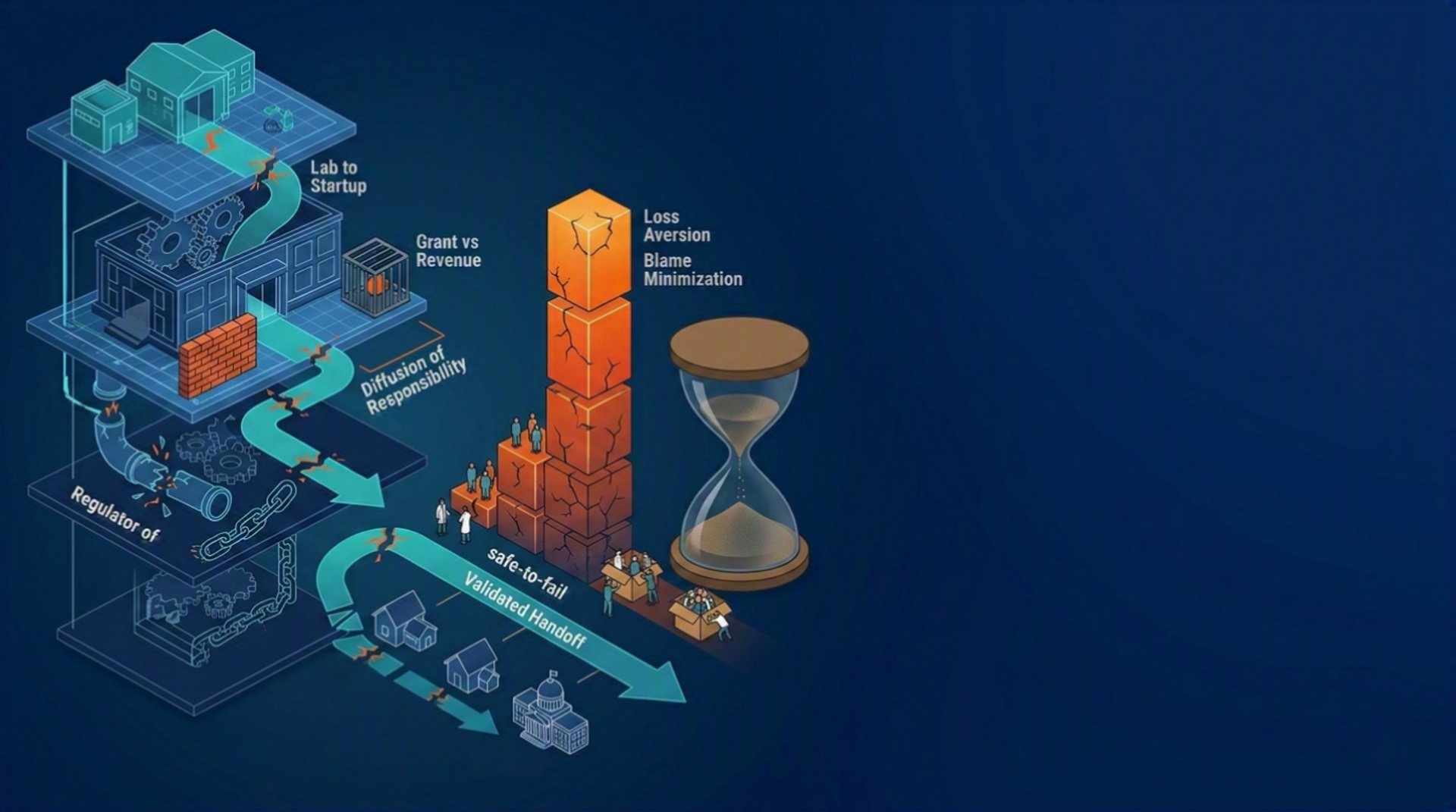
Culture, capital, and policy compound on each other as a breakthrough tries to move from lab bench to clinical adoption. A hospital manager defers an adoption decision because nobody owns the transition. A pension fund sends capital abroad because no domestic fund is large enough to take it. A ministry buries an access pathway in a sequential review process built for caution, not speed. Three different mechanisms, one shared outcome: what should take months takes years, and what should stay Canadian doesn't.
The Psychological Stack
At every level of the system, leadership defaults to the same three patterns. Inertia — status quo bias, where the default requires no decision at all. Diffusion of Responsibility — unowned handoffs, where everyone assumes someone else owns the transition. And Risk Aversion — blame-minimization, where quiet inaction is career-safe and visible innovation isn't. None of these are failures of individual judgment. They're the predictable output of a system where the burden of proof for change is set far higher than the burden required to keep things as they are.
Pillar 2: Capital and Scale Vacuum
Canada funds early discovery and starves growth-stage scale. Domestic venture funds average $150–300 million and write $10–20 million cheques — enough to carry a company through early rounds, but far short of what a late-stage scale-up needs. Canadian pension capital, which actively co-invests in life sciences abroad, allocates only a fraction of that appetite at home — not for lack of returns, but because no domestic fund is large enough to absorb a pension-scale cheque. The result: accelerators coach founders toward an early foreign sale, because staying independent to G7 scale was never structurally financed as an option.
A balkanized, sequential pipeline — regulatory approval, health technology assessment, and provincial pricing negotiation, each waiting on the last to finish — turns a straightforward approval into a multi-year queue before a single patient gains access. It pairs with a hospital procurement system built for short-term unit-cost containment, where the department that pays for an innovative tool rarely captures the downstream savings it generates. The incentives at every gate reward caution, not adoption.
Pillar 3: Policy and Regulatory Ossification


Pillar 1: Cultural and Behavioural Paralysis
The "Build-and-Sell" Default
The Sequential Assessment Treadmill

Built For Canadian Realities
For two decades, Canadian leaders have been offered two flawed prescriptions for our innovation crisis.
The first is the Silicon Valley copy-paste. Policy makers and incubators try to import American venture and accelerator models into Canada. But those playbooks were built for a country with massive private capital depth, competing private health plans, and a huge domestic market. Applying them to a country with $150-million to $300-million venture funds, single-payer health monopsonies, and 598 to 906-day reimbursement treadmills doesn't create growth. It creates a system that subsidizes early research with Canadian tax dollars only to export the resulting companies and IP abroad.
The second is the generic consulting cliché. Traditional corporate advisors diagnose our problem as a lack of "risk culture" and preach vague slogans about "fostering an entrepreneurial mindset." But telling a hospital CFO, regulator, or public servant to "take more risks" in a system that punishes visible errors while rewarding quiet inaction is useless. Without structural cover, asking individuals to be brave is not a strategy.
Augmentios is built on a fundamentally different architecture:
A Canada-Specific Diagnostic: We don't apply generalized business theories. We provide an unvarnished, empirical audit of where Canada's specific health innovation, tax, capital, and regulatory pipelines break down.
Anchored in Deep Tech and Healthcare: This framework wasn't designed for consumer software apps with fast feedback loops. It was engineered in deep tech and life sciences, where clinical runways take a decade and the cost of paralysis is measured in human lives, lost economic sovereignty, and healthcare sustainability.
Whole-System Architecture: We don't treat commercialization as an isolated startup problem. We look across the entire value chain—from the university lab bench and incubator to venture syndicates, PMPRB and pCPA pricing gatekeepers, and hospital procurement protocols.
Behavioral Science and Positive Psychology: We replace vague calls for "risk-taking" with actionable, behavioral de-risking tools. Grounded in Prospect Theory and decision-rigor frameworks, we equip leaders with structural mechanisms—such as Pre-Mortems, Decision Journals, and Safe-to-Fail Sandboxes—that give administrators the psychological safety and cover required to transition from defensive inaction to active adoption.
That is why this isn't an imported framework: it was engineered inside the Canadian system's actual constraints, not adapted from a foreign market that doesn't share them.
Why twenty years of innovation reports, corporate consultants, and Silicon Valley playbooks haven't fixed the Canadian crisis.
Who This Is For
Founders & Scaling Life Science Companies
You've built world-class science, but you're running on two treadmills at once. The funding treadmill, trying to raise growth capital, and the assessment treadmill, trying to get through pricing, regulatory review, and reimbursement negotiation before a patient ever sees it. Use this framework to diagnose where handoffs break across both, and to find the capital — cross-border syndicates, non-U.S. institutional and sovereign pools, reciprocal market-entry partnerships — that lets you build, scale, and stay headquartered in Canada instead of taking a premature discount trade sale.
Policy Makers & Regulators
Investors and Venture Boards
Health System and Hospital Leaders
Canada subsidizes the discovery and exports the payoff. SR&ED and IRAP fund early research with no mechanism tying that funding to where the resulting company or IP ends up — so Canada pays for the science and another country captures the exit. Meanwhile the Maple 8 pension funds co-invest in life sciences abroad while allocating almost nothing at home, for lack of a domestic vehicle large enough to absorb a pension-scale cheque. Use this framework to build the fix: investment and loss-reinvestment credits that keep early capital recycling in Canada, a CDPQ-style dual mandate for the Maple 8, and a $100-million-plus VCCI threshold that stops slicing public capital too thin to lead a real round.
Your best portfolio companies are solving the science and losing the company. Canadian funds average $150–300 million and write $10–20 million cheques — enough for early rounds, but too small to lead the $50-million-plus growth round a proven company needs to stay independent. VCCI doesn't fix this; it fragments public capital into allocations too small to matter, while pension capital that actively co-invests in life sciences abroad allocates almost nothing at home. Use this framework to access the alternative: cross-border syndication with non-U.S. institutional LPs and sovereign allocators, and reciprocal market-entry structures that keep capital — and ownership — in the Canadian parent company.
The budget that pays and the budget that saves are rarely the same one. Procurement scores bids on upfront unit cost, but the department absorbing that cost rarely captures the downstream savings an innovative diagnostic or therapy generates. That mismatch is what keeps proven, homegrown technology stuck in pilot after pilot. Use this framework to shift evaluation toward the $3 Procurement Multiplier — roughly $3 of downstream value for every $1 spent — and to give administrators Safe-to-Fail Sandboxes: bounded conditions that let them adopt validated innovation without carrying the full risk of being first.






This innovation framework is built for the people living inside the problem--not observing it from the outside.